An overdue invoice email works best when it is short, specific and matched to the situation. A first nudge a few days late should not read like a message sent after a missed promise. Below are seven complete templates for one invoice as it moves from a friendly check-in to a final notice, plus rules for replies, disputes, partial payments and payment claims.
These are drafts for you to read, edit and send from your own mail app. Adjust the tone to your client and your agreement.
An unpaid invoice email can be appropriate before or after the due date; these examples specifically cover the overdue stage. The past due invoice guide explains the wider process.
The example used on this page
All templates follow one fictional case. Alex, a designer, issued invoice INV-104 to Jordan for USD 1,200 on March 2, 2026. The terms were Net 30 with March 2 as the agreed start date, so the due date is April 1, 2026 (30 calendar days). The follow-up dates below, April 4 and April 8, are illustrations of a sequence, not proven best dates. Choose dates that fit your own agreement and client.
Check before sending a past due invoice email
- Amount. Confirm the balance. Look for a payment you did not record or a change order you never invoiced.
- Contact. Make sure [Contact name] is the person who pays, not only the person who approved the work.
- Receipt. Check that the invoice actually reached the client, and attach it again if unsure.
- Dispute or reply. If the client has already disputed the invoice, or asked you to wait, deal with that first. A standard reminder will not help.
If the invoice is not yet late, use invoice follow-up emails. This page starts after the due date has passed.
Seven overdue invoice email templates
1. First overdue nudge
When to send: a few days after the due date, with no earlier reply. Example: April 4.
Subject: Invoice INV-104 is now past due
Hi Jordan,
Invoice INV-104 for USD 1,200.00 was due on April 1, 2026, and I don't see it as paid on my side. It may simply have slipped through.
The invoice is attached again. Could you tell me when it is scheduled for payment, or let me know if anything is holding it up?
Thanks, Alex
2. Second reminder with a requested date
When to send: after template 1 gets no reply. Example: April 8.
Subject: INV-104: USD 1,200.00, seven days past due
Hi Jordan,
Following up on invoice INV-104 for USD 1,200.00, which was due on April 1, 2026. I haven't had a reply to my note on April 4.
Could you confirm by April 11 when payment will be made? If something is wrong with the invoice, tell me what and I'll look at it right away.
Thanks, Alex
3. Contact check
When to send: repeated silence, when you suspect the message is not reaching the person who pays.
Subject: Who should receive invoice INV-104?
Hi Jordan,
I've sent two notes about invoice INV-104 for USD 1,200.00 (due April 1, 2026) and want to be sure they reached the right person.
Is there someone in accounts payable I should send this to directly? I'm happy to resend the invoice to them.
Thanks, Alex
4. After a promised payment date is missed
When to send: the client gave a date and nothing arrived. Check your records first.
Subject: INV-104: payment expected on [Promised date]
Hi Jordan,
You mentioned payment for INV-104 would go out on [Promised date]. I haven't received it as of today.
Could you confirm what happened and give me a date I can plan around? The balance is USD 1,200.00.
Thanks, Alex
5. After a partial payment
When to send: only after you have verified the amount received. Suppose USD 400.00 arrives.
Subject: INV-104: USD 800.00 remaining after your payment
Hi Jordan,
Thank you for the USD 400.00 payment toward INV-104, which I have confirmed on my side. That leaves USD 800.00 of the original USD 1,200.00.
Could you let me know when I can expect the remaining USD 800.00?
Thanks, Alex
6. Final notice
When to send: after earlier reminders and no resolution. State a next step you are actually prepared to take.
Subject: Final notice: INV-104, reply needed by [Date]
Hi Jordan,
Invoice INV-104 for USD 1,200.00 was due on April 1, 2026 and remains unpaid. I have written several times.
Please pay or reply with a payment date by [Date]. If I don't hear from you, my next step will be [next step you intend to take, for example pausing further work under our agreement].
I would rather settle this directly, so please get in touch.
Regards, Alex
7. Dispute or question received
When to send: the client says something is wrong with the invoice or the work.
Subject: Re: INV-104, your question about the invoice
Hi Jordan,
Thanks for telling me. I want to understand the concern about INV-104 before we discuss payment.
Could you tell me which line or deliverable you are questioning? Once I have that, I'll check it and reply by [Date] with either a correction or an explanation.
Thanks, Alex
An outstanding payment reminder should name the balance
“Outstanding” describes what remains unpaid; it does not by itself mean the invoice is late. Check the due date before using overdue wording. With a verified partial payment, state the original invoice reference and the remaining balance, not the full original amount. If several invoices are open, list them separately so the client can match each reference and currency. Do not combine currencies into one unsupported total.
Rules for using an overdue invoice email
- One invoice, one thread. Keep the same invoice number and a consistent subject so the history reads clearly.
- Name the amount and original due date every time.
- Make each message a little firmer only if the facts support it. Don't escalate while a dispute is open.
- Stop standard reminders when the client replies. Read the answer and respond to it.
- A promise is not payment. If a client gives a date, note it and check on that date. Your balance stays the same until money arrives.
- A payment claim is not payment. If the client says it was paid, ask for a payment reference or date, check your own account, and keep the balance at USD 1,200.00 until you confirm it. Only a verified partial payment reduces it, so USD 400.00 verified leaves USD 800.00.
- Don't threaten what you won't do. A next step should be contractual and practical. If you are considering legal action, check the rules that apply to you first.
What to attach to your overdue invoice email
Attach the invoice and include a payment link or bank instructions if you normally provide them. Add other documents only when the client asks, such as a purchase order number or the signed scope.
If an overdue invoice reminder email gets no reply
Try another channel, such as a short call or a text message. For options after that, read what to do with an unpaid invoice and how a demand letter fits in.
Choose a past due invoice email template for the current balance
MoneyNudge shows which quotes and invoices need a follow-up today. It drafts each follow-up from your own template; you review it and send it from your own email. It never emails your clients on its own. It keeps a record of what you marked as sent, and when.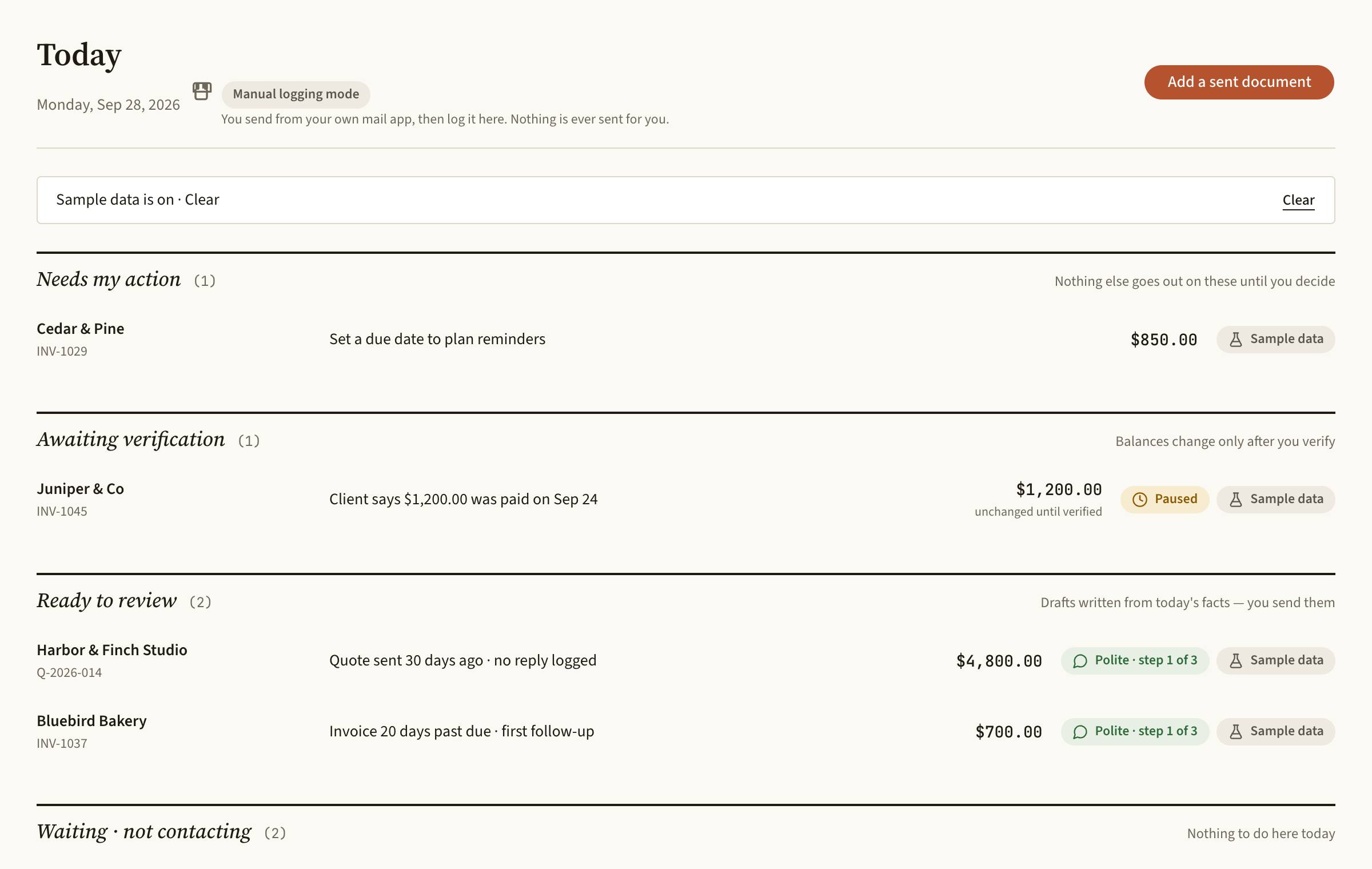 Sample data. Fictional invoices in the Today view.
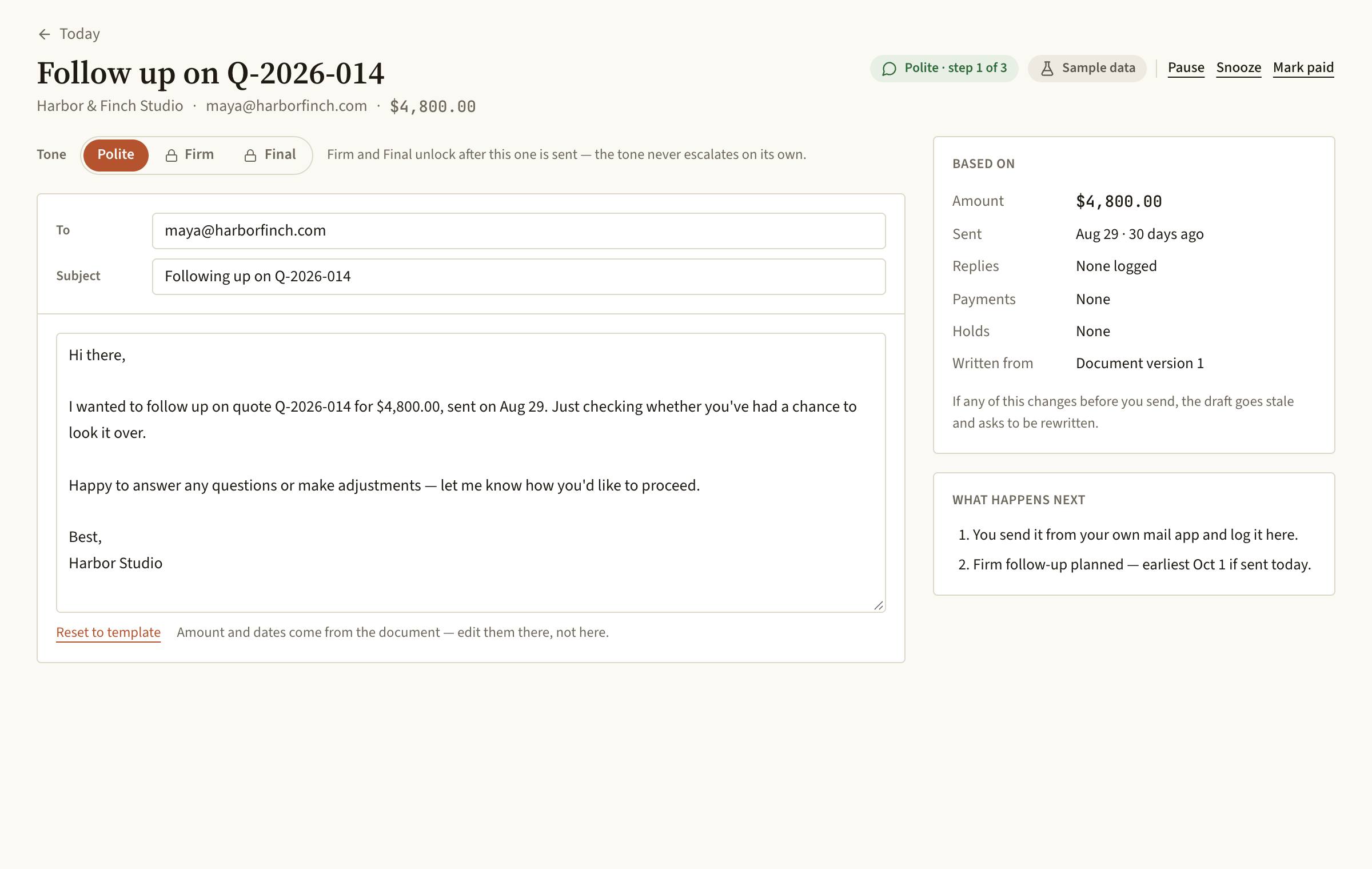 Sample data. Review and edit a draft before sending it from your own mail app.
Frequently asked questions
How do you write an email about an overdue invoice?
Keep it short: the invoice number, the amount, the original due date, and one clear question or request. Match the tone to how late the payment is. A one-day reminder should read as a friendly assumption that it was missed; a thirty-day email should state a deadline plainly. Avoid vague language like 'whenever you get a chance,' since it signals the payment is not really a priority. End with a specific next step, whether that is a payment link or a date you would like a reply by.
How do you politely say an invoice is overdue?
State the fact plainly and skip the apology or the accusation: the invoice number, the amount, and how late it is. Ask a direct, open question, such as whether it was received, rather than assuming the client is avoiding you. Offer an easy way to act, like a payment link, in the same message. Politeness here mostly means staying factual and giving the client a graceful way to simply pay, rather than making them explain themselves before you will accept payment.
What subject line should an overdue invoice email have?
Put the invoice number and the situation in the subject line itself, so it is useful even if the client only reads their inbox list. "Invoice INV-1042 is now past due" works better than a vague "Following up," because it tells the reader exactly what to expect before they open it. As the invoice gets later, the subject line can get more direct, moving from a soft check-in to something like "Action needed" for a final notice.
How many reminders should you send before a final notice?
There is no fixed count that fits every overdue invoice. Review the agreement, contact history and any response before choosing a final notice. Each earlier note should have a clear job rather than merely becoming louder. A final notice should state an intended next step you are actually prepared and permitted to take, not an invented threat.
Is it OK to copy someone else at the client's company?
If another person handles the invoice, ask for the correct billing contact or use an authorized contact from the existing project. Explain why you are including them and share only relevant invoice details. Do not copy unrelated people to pressure or embarrass the client. Check any confidentiality obligations and the client's preferred communication route before adding recipients.