An invoice reminder is a short message that points a client back to one specific invoice: its number, the amount, the due date and what you would like them to do. The same invoice can need a reminder before the due date, on it, or after it passes. The wording changes with each of those moments.
This page maps those moments and sends you to the page with complete wording for each one. If your question is broader than invoice timing, start with payment reminders instead.
Four stages for an invoice reminder
| Moment | What is true | What the message does | Where to go |
|---|---|---|---|
| Before the due date | The invoice is sent and not yet due | Confirms it arrived and states the date | Invoice follow-up email templates |
| On the due date | Payment is due today | Restates amount and date, assumes nothing is wrong | Invoice follow-up email templates |
| After the due date | The date has passed without payment | Asks what is holding it up, then asks for a date | Overdue invoice email templates |
| The client says they paid | A payment is claimed but you have not confirmed it | Pauses chasing until you check | See "Claimed is not verified" below |
Read the matching guide: Invoice follow-up email templates, Overdue invoice email templates.
Before the due date: an invoice payment reminder
A reminder before the due date is optional. Its job is small: confirm the invoice reached the right person and say when it is due. It also lets the client mention a missing purchase order or a wrong name while that is still easy to fix.
Skip it if the client always pays promptly and an extra message would feel like noise. Send it if the invoice went to a shared inbox, a new client or an accounts team you have not dealt with before.
With Net 30 terms, work out the real due date first. Counting from the wrong start date is an easy way to chase too early. The Net 30 calculator does the calendar-day arithmetic, and what Net 30 means explains how the start date is agreed.
On the due date
On the due day, restate the invoice number, amount and date, and mention where the payment details are. Keep the note neutral and friendly, and leave room for the client to explain any delay.
After the due date
Once the date has passed, make each message do a slightly different job:
- Ask first. Check whether something is blocking payment and say how to pay.
- Be specific. Name the invoice, the amount and how many days it is past due.
- Ask for a date. Request a day you can expect payment, so the next step is not left open.
Stay factual throughout. Formal letters, late fees and other steps depend on your written agreement and where you work. Check your contract, or ask a qualified professional, before you write anything that cites a right or a consequence.
The overdue invoice templates cover reply, dispute and partial-payment situations in full. If you are still working out why the invoice is unpaid, read the unpaid invoice guide. For the conversation itself, see how to ask a client for payment.
Claimed is not verified
Sometimes the answer to a reminder is "I already paid." Treat that as information, not as a closed invoice.
- Note the claim and pause further reminders on that invoice.
- Check your own bank or payment account for the money.
- Leave the outstanding balance as it was until you have seen the payment.
- Once a partial payment is verified, reduce the balance by that amount, in the same currency.
One fictional invoice, start to finish
In this fictional example, Alex, a designer, issues invoice INV-104 to Jordan on March 2, 2026 for USD 1,200. The agreed terms are Net 30, counted from March 2, so the due date is April 1, 2026.
| Date | Stage | Balance |
|---|---|---|
| March 29, 2026 | Optional note before the due date | USD 1,200 |
| April 1, 2026 | Due date | USD 1,200 |
| April 4, 2026 | First follow-up, 3 days past due | USD 1,200 |
| April 8, 2026 | Second follow-up, 7 days past due | USD 1,200 |
These follow-up dates are examples, not proven best timings. Adjust them to your client, your contract and how you work.
Suppose Jordan replies on April 5 that he has paid USD 400. Until Alex sees that money arrive, the balance stays USD 1,200. After Alex verifies the USD 400, the balance is USD 800, and the next message asks for the remaining USD 800.
A simple invoice reminder schedule
Choose the next check by the invoice stage, then write down what would make you stop or change it. Before the due date, a receipt check may be enough. On the due date, state the amount and payment method. Afterward, ask what is holding payment up and request a date. A reply, dispute or payment claim interrupts that plan: review the information first instead of mechanically sending the next note. These are planning choices, not a tested optimum.
April 4, 2026 in the example is a Saturday. If you only contact clients during their working week, you might review the message on Monday, April 6 instead. That is your communication choice and does not move the agreed invoice deadline.
Write the last contact date and the reason for the next check beside each invoice, so a postponed reminder does not become an unexplained task.
Review the next action before it is due
Keep the invoice reference, outstanding balance, last contact, pause reason and next review date together. The next review date means “check the situation”, not “send regardless”. If the client asked you to wait and also disputed the amount, resolving one issue does not resolve the other. Read the last reply before opening a saved draft and verify that the recipient, amount and intended question still fit. An undated request to stop contacting the client needs its own deliberate review; it should not disappear merely because a scheduled reminder date arrives.
Recording replies and pauses by hand
MoneyNudge shows which quotes and invoices need a follow-up today. It drafts each follow-up from your own template; you review it and send it from your own email. It never emails your clients on its own. It keeps a record of what you marked as sent, and when.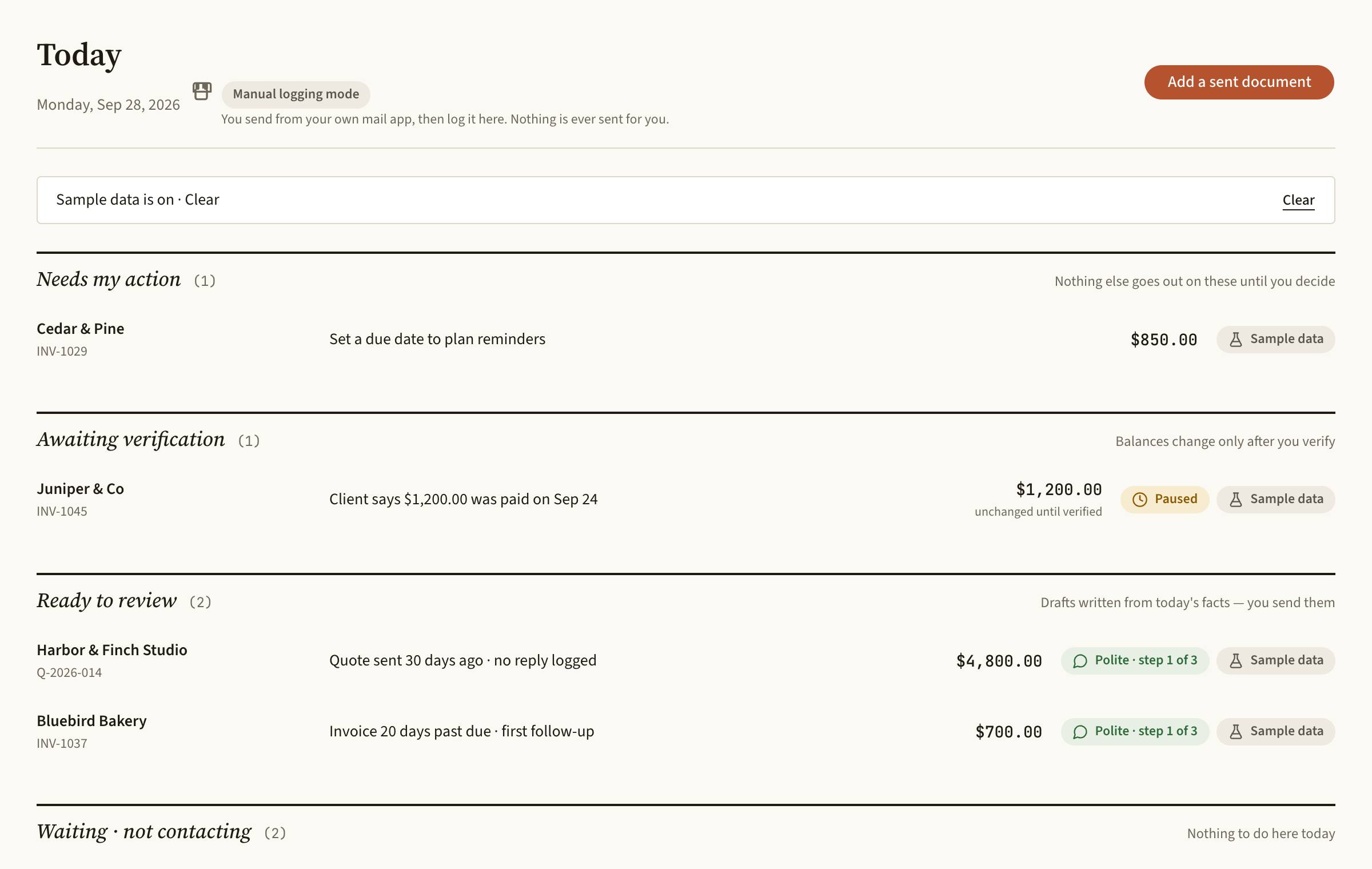 Sample data.
Keep a reply, dispute and payment claim as separate entries in your own follow-up record. If a pause has an agreed review date, check that date and any other unresolved issue before contacting the client again. A payment claim still needs verification; do not resume routine reminders simply because a calendar date passed.
Continue with invoice reminder software comparison.
More guides in this section
- Invoice follow-up email
Invoice follow up email templates for a quick check-in, a due-date nudge and an overdue request, plus the timing and subject lines that get invoices paid.
Frequently asked questions
How do you write a reminder for an unpaid invoice?
State the invoice number, the amount, and the original due date first, so there is no confusion about which invoice you mean. Say plainly what you would like the client to do, such as paying now or confirming a date, and include a working way to pay. Keep the tone matter-of-fact rather than apologetic once the invoice is genuinely late, and always leave a way for the client to flag a problem instead of ignoring the message.
How many invoice reminders should you send?
Choose a sequence you can review, not a fixed count claimed to work for everyone. You might plan a receipt check, a due-date note and later checks for an open balance. Stop that routine when a client replies or raises a problem. If reminders remain unanswered, confirm the contact and consider another suitable next step.
When should you send the first invoice reminder?
A receipt check before the due date can help when you sent the invoice to a new contact or shared inbox. Waiting until payment is due is another reasonable choice. Use the agreement and any client response to decide. The calendar examples show possible dates, not evidence that a particular day produces better payment results.
Should invoice reminders be automated?
Choose according to how you want to review messages and handle exceptions. Built-in automation can send scheduled invoice reminders, while a manual approach lets you read each draft first. In either case, decide what happens when a client replies, disputes the invoice or claims payment. Timing alone does not tell you whether the next message is appropriate.
What's the difference between an invoice reminder and a demand letter?
An invoice reminder is a routine message that identifies the amount and date and asks for an update or payment. A demand letter is a formal request that may describe an intended next step. Its wording and any consequences depend on the agreement and local rules. Do not copy legal threats into a routine email simply to sound firm.