A payment reminder is a short message telling a client that an invoice is coming due, due today or late, and how to pay it. Before and on the due date, keep it routine. Once the invoice is late, stay calm, name the amount and ask for a specific date.
This page helps you pick the stage and the channel. Full sets of wording live on the pages linked below, so you can go straight to the one that fits your situation.
What every payment reminder needs
Some people search for a "reminder of payment." It means the same thing. Whatever the channel, include:
- The invoice number and the exact amount still owed
- The due date, or how many days past it you are
- A working payment link or plain payment instructions
- One specific ask, such as a date you would like payment by
- Your name and an easy way to reply
Skip "whenever you get a chance." It gives the client nothing to act on. If the invoice never stated when payment was expected, fix that first: the payment-term guide explains how to state a deadline before writing reminders.
Before choosing wording, check the payment record again so an older balance does not reach the client.
Choose your stage
| Where you are | What the message does | Go to |
|---|---|---|
| Invoice sent, due date still ahead | Confirms receipt and puts the date on the client's radar | Invoice follow-up email templates |
| Due today | States the amount and how to pay | Invoice follow-up email templates |
| A few days to weeks late | Names the days overdue and asks for a payment date | Overdue invoice email templates |
| Late and you are not sure why | Works out whether it is a missing invoice, an approval delay, a dispute or silence | Unpaid invoice guide |
| You need to raise payment in conversation | Plain phrasing for talking, not only writing | How to ask a client for payment |
| You prefer a quick message | Shorter wording for texting | Ask for payment by text |
| Unsure what "Net 30" means or when it starts | Explains the term and the date arithmetic | Net 30 explained and the Net 30 calculator |
| It is a quote, not an invoice | Different document, different follow-up | Quote follow-up |
Read the matching guide: Invoice follow-up email templates, Overdue invoice email templates, Unpaid invoice guide, How to ask a client for payment, Ask for payment by text, Net 30 explained, Net 30 calculator, quote follow-up decisions. For the full lifecycle of an invoice reminder, from sending through to payment, see the invoice reminders overview. For the late-payment side, see past due invoices.
One fictional example
Alex, a freelance designer, sends Jordan invoice INV-104 for USD 1,200 on March 2, 2026. They agreed Net 30 from March 2, counted in calendar days, so the due date is April 1, 2026.
- April 1: the due-day message. Amount, due date, how to pay.
- April 4: a first late check, assuming the invoice may simply have slipped past Jordan.
- April 8: a firmer message asking for a specific payment date.
These dates are an illustration, not a proven best schedule. Adjust them for your client, the invoice size and how you normally work together.
Short wording by channel
These are deliberately brief starting points. Replace the brackets and edit them so they sound like you.
Email before the due date
Subject: Heads-up on invoice [Invoice number]
Hi [Client name],
Invoice [Invoice number] for [Amount] is due on [Due date]. Nothing you need to do today; I just wanted it on your radar. You can pay here: [payment link or instructions].
If anything is unclear, reply and I will sort it out.
[Your name]
Email, first late check
Subject: Checking on invoice [Invoice number]
Hi [Client name],
Invoice [Invoice number] for [Amount] was due on [Due date], and I have not yet seen payment. It may have slipped past you. Could you confirm when I can expect it?
Payment details: [payment link or instructions].
[Your name]
Text
Hi [Client name], it's [Your name]. Invoice [Invoice number] for [Amount] was due on [Due date]. Could you let me know when it will be paid? Thanks.
Hi [Client name], quick check on invoice [Invoice number] ([Amount], due [Due date]). Is payment scheduled? I can resend the invoice if that helps.
Use text and WhatsApp for clients you already message about the work. Use email when the invoice has to reach an accounts person or be forwarded for approval, since an email holds the invoice and payment details together.
When the client replies
A reply changes what you should send next. Do not keep to the schedule on autopilot.
- "I'll pay on [date]." Note the date and hold off until it passes. If it passes without payment, say so plainly and ask for a new date.
- "I already paid." Treat that as a claim, not as received money. Check your own bank or payment account first. Until you have confirmed it, the balance is still the full amount. In the example, INV-104 stays at USD 1,200.
- "I paid part of it." Reduce the balance only after you have confirmed the amount. If Jordan's USD 400 payment is confirmed, USD 800 remains, and your next message should name that USD 800 against INV-104.
- "There's a problem with the invoice." Stop sending payment reminders and answer the question. Resume only once the issue is settled.
Late fees, pausing work or other consequences depend on what your contract or terms say and on the rules where you work. Check those before mentioning any of them in a message.
Agree the channel before repeating a reminder
Use an address or number the client has agreed to use for the work. If they ask you to stop using a channel, note that preference and choose a permitted alternative together. A quick text should not expose invoice details in a shared or public conversation. Keep the full invoice and any disagreement in the appropriate private thread.
Keep track of what you have sent
MoneyNudge shows which quotes and invoices need a follow-up today. It drafts each follow-up from your own template; you review it and send it from your own email. It never emails your clients on its own. It keeps a record of what you marked as sent, and when.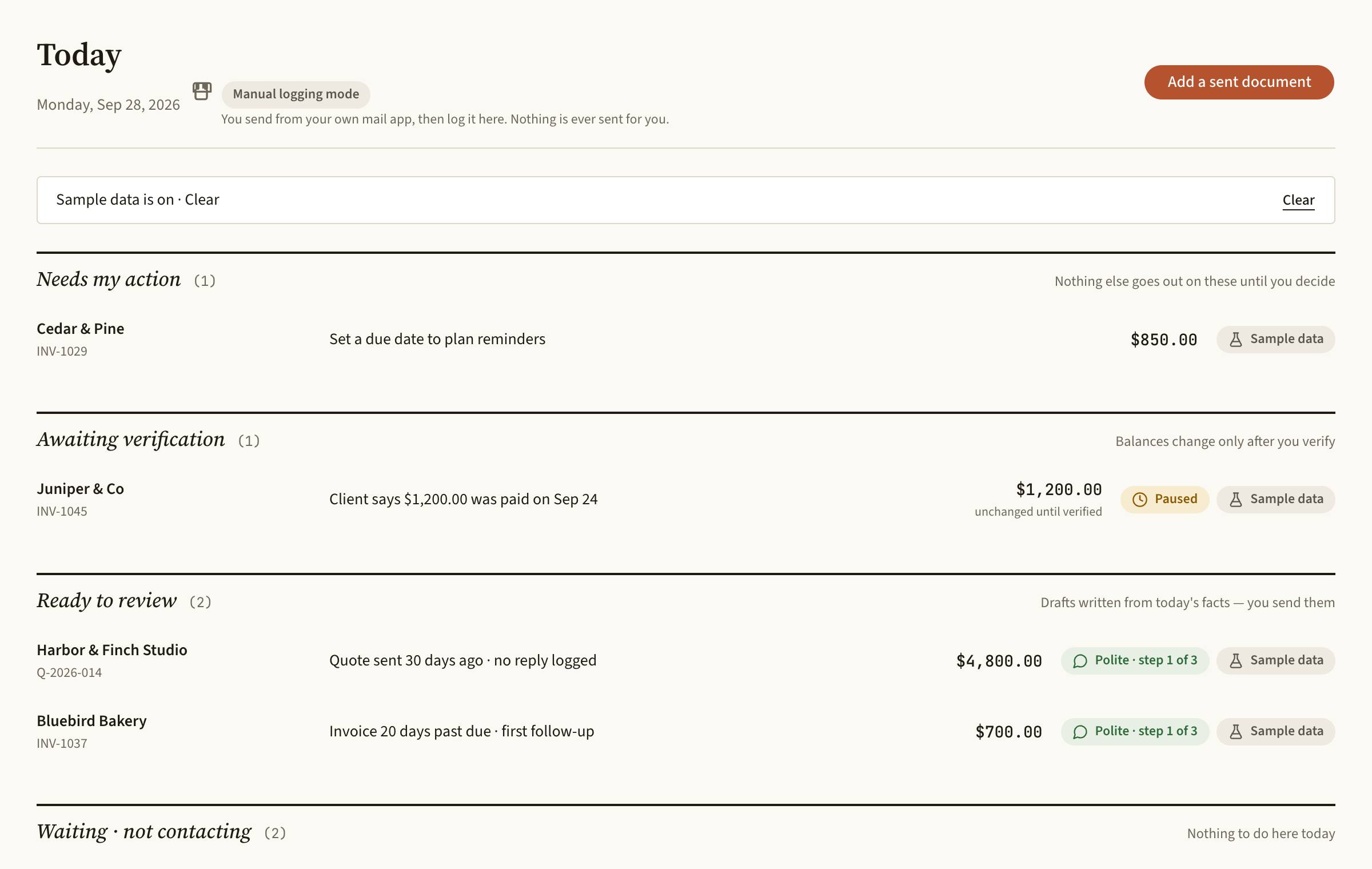
Sample data.
More guides in this section
More pages are on the way.
Frequently asked questions
How do you politely remind someone to pay?
Keep it short and assume the invoice was simply overlooked. State the invoice number, the amount, and the due date, and make it easy to pay by including a link or clear instructions. Skip the apologetic tone for a reminder sent before or on the due date; it is routine, not an imposition. Once it is genuinely late, stay calm and specific about what you need and by when, rather than hinting.
How soon after the due date should you send a payment reminder?
First confirm the agreed due date and check whether payment has already arrived. A short note soon afterward is one option, but use the client's actual response and working hours when choosing the day. The fictional dates in this guide are planning examples. If the client has disputed or claimed payment, resolve that information before sending another reminder.
How many payment reminders should you send?
There is no universal count or proven sequence on this page. Decide what each message needs to accomplish, then review the response before continuing. A receipt check, a request for a payment date and a contact check do different jobs. If several notes get no reply, consider another agreed channel instead of repeating the same wording.
What should a payment reminder email say?
Include the invoice number, the exact amount, the due date or how many days past it you are, and a clear way to pay. State one specific ask, such as a date you would like payment by, rather than a vague request to take care of it soon. Keep the tone matched to the stage: friendly before the due date, plain and direct once it is late.
Is it rude to send a reminder before the due date?
No. A short courtesy note a few days before an invoice is due reads as organized, not pushy, especially for a new client or a larger amount. Keep it brief and low-pressure, more of a heads-up than a request. It only starts to feel rude if it is frequent, demanding, or sent for very small, routine invoices where the client has always paid on time.